
Granules are the crushed mineral pieces bonded into the asphalt surface of every shingle on your roof, and they carry a much larger job than color alone. That mineral layer blocks ultraviolet light, adds fire resistance, and protects the asphalt coating that actually keeps water out of your home. When those granules begin washing into your gutters in heavy amounts, the shingle underneath starts aging far faster than the manufacturer ever intended it to. Early fall is when homeowners across Northwest Arkansas tend to notice the problem, because spring hail and a long summer of direct heat have already done their damage, and the first cool rains of the season flush all that loose material down the downspouts and onto the driveway. A small amount of shedding from a brand new roof is completely normal; a pile of sand like grit at the base of a downspout on a roof that is ten years old is a different story. Granule loss almost never stays cosmetic for long, because once the asphalt below is exposed to direct sun it dries out, cracks, and stops shedding water the way it should. The repair cost climbs quickly once moisture reaches the decking and the attic. This guide covers what causes granule loss, how to identify it from the ground, and what your options are once you find it.
What Shingle Granule Loss Means for the Health of Your Roof
A shingle is built in layers, and each layer depends on the one above it. The fiberglass mat gives the shingle its shape and tear strength, the asphalt coating gives it waterproofing, and the granules protect that asphalt from the sun. Remove the top layer and the entire system starts to fail from the outside in. Ultraviolet radiation breaks down the oils in asphalt, which causes the shingle to shrink, harden, and eventually crack along the exposed areas. In a climate like Arkansas, where roof surface temperatures regularly climb past 150 degrees on summer afternoons and then drop sharply during fall cold fronts, that breakdown accelerates. The visible bald spots you see are the last stage of a process that started long before the shingle looked bad from the driveway.
Normal Shingle Granule Loss Compared to Early Shingle Granule Loss
Every asphalt shingle sheds a small amount of loose granules during the first few months after installation, and this is expected rather than alarming. During manufacturing, more granules are pressed into the asphalt than can permanently bond to it, so the excess sits on the surface until rain and wind carry it away. A new roof will typically send a light dusting of material into the gutters after the first several rainstorms, and that shedding tapers off within the first year. If your roof was installed recently and you find a thin layer of grit in the gutter trough, there is usually nothing wrong. The tell is volume and timing. Ongoing heavy loss years after installation points to a shingle that is losing its protective surface rather than simply releasing extra material.
Early granule loss, meaning significant loss on a roof under ten years old, usually has a specific cause behind it rather than simple wear. Impact from hail, abrasion from tree limbs, foot traffic from installers or satellite technicians, and pressure washing all strip granules mechanically. Manufacturing defects also exist, and a shingle with poor asphalt quality or weak granule adhesion will shed at a rate no reasonable owner should accept. Blistering is another frequent culprit, where trapped moisture or volatile compounds inside the asphalt expand under heat and pop open small craters that release granules in clusters. Attic ventilation plays directly into blistering, because superheated air trapped under the deck cooks the shingle from below. Identifying which of these is responsible matters, because some causes are covered by a manufacturer warranty and others are covered by a homeowner insurance policy.
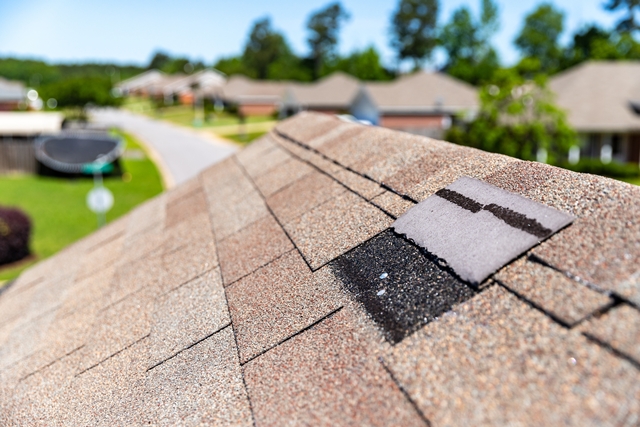
Late stage granule loss on a roof approaching the end of its service life looks different, and it tends to be widespread rather than concentrated. Instead of a few bare patches, you see broad areas of dull, faded shingle with the darker asphalt showing through across entire slopes, most often on the south and west facing sides that absorb the most sun. The shingles feel brittle underfoot and the edges may curl upward or cup in the middle. A typical three tab shingle in this region lasts somewhere in the range of fifteen to twenty years, while architectural shingles often run longer with proper ventilation and installation. Once uniform granule loss appears across a roof of that age, repairs stop making financial sense because the surrounding shingles are in the same condition as the ones you would replace. At that point, planning a full replacement before winter arrives protects both the structure and your budget.
What Causes Shingle Granule Loss on Arkansas Roofs
Hail is the single most common cause of sudden granule loss in Northwest Arkansas, and our region sits in an active corridor for spring and early summer storms. When a hailstone strikes a shingle, it displaces granules at the point of impact and often bruises the fiberglass mat underneath, creating a soft spot that will crack open over the following seasons. These impact marks appear in a random scatter across the slope rather than in any pattern, which is one of the ways an experienced inspector separates hail damage from ordinary wear. Soft metal surfaces nearby usually confirm the event, since hail leaves dents in gutters, vent caps, flashing, and air conditioner fins. Wind driven rain compounds the issue by scouring the loosened granules away immediately after the storm passes. Many homeowners never see this damage from the ground, which is why a roof can pass a casual glance and still be compromised.
Heat and poor attic ventilation cause a slower version of the same problem, and this one builds over years rather than minutes. An attic that lacks balanced intake at the soffits and exhaust at the ridge traps hot air directly against the underside of the roof deck, raising shingle temperatures well above what they would otherwise reach. That constant heat drives the volatile oils out of the asphalt, leaves the shingle stiff, and weakens the bond holding granules in place. Blisters form, pop, and leave behind small pits that spread as water flows over them. Proper ventilation follows a balanced design that moves air continuously from the eaves up through the ridge, and correcting it during a roof replacement often extends the life of the new system by years. Homeowners who skip this step frequently see the same premature granule loss on the second roof that they saw on the first.
Mechanical damage and water concentration round out the list of common causes. Overhanging tree limbs drag across shingles every time the wind blows, sanding the surface down along a predictable arc. Walking on a roof, especially during cold weather when shingles are stiff or during peak heat when the asphalt is soft, crushes and dislodges granules under every step. Pressure washing is particularly destructive and should never be used on asphalt shingles, because the force strips granules faster than any storm. Water flowing off an upper roof section onto a lower one, or spilling out of a clogged gutter and back under the shingle edge, wears a concentrated channel where granules disappear first. Improperly terminated downspouts and missing kickout flashing create the same effect near walls and valleys. Fixing the drainage problem is part of any real repair, because replacing shingles without addressing the water path just repeats the failure.
How Shingle Granule Loss Damages the Layers Below
Once granules are gone, ultraviolet exposure begins degrading the asphalt within a single season. The shingle loses flexibility, and a material that once expanded and contracted with temperature swings now resists that movement and cracks instead. Those cracks are narrow at first and easy to overlook, but they open wider each time the temperature drops overnight and climbs again the next afternoon. Water follows the cracks down to the underlayment, which is designed as a secondary barrier rather than a primary one. Underlayment holds up for a while, and that delay is exactly why so many homeowners believe a bare shingle is harmless. The leak is not absent; it is simply pending.
When water finally reaches the roof deck, the damage stops being a roofing problem and becomes a structural and interior problem. Oriented strand board and plywood decking swell when saturated, lose fastener holding strength, and begin to delaminate in layers. Wet decking sags between rafters and creates visible waves across the roof surface that no amount of shingle work will hide. Insulation in the attic compresses and loses its thermal value once damp, which raises heating and cooling costs across the entire house. Moisture that migrates into wall cavities stains drywall, lifts paint, and swells trim. Mold growth can begin within roughly twenty four to forty eight hours of sustained moisture, and remediation costs far more than the roof repair that would have prevented it. If a leak has already reached your ceiling or attic insulation, our water restoration services can dry the structure properly before mold takes hold.
Granule loss also affects fire resistance and energy performance, which are the two functions homeowners forget entirely. The mineral surface contributes to the Class A fire rating that most asphalt shingles carry, and stripping it away reduces that protection. Reflective granules also bounce a portion of solar energy off the roof rather than allowing it to soak into the asphalt and radiate into the attic. A roof with heavy granule loss absorbs more heat, which raises attic temperatures, strains the air conditioning system through the long Arkansas summer, and speeds the aging of everything stored up there. Insurance carriers pay attention to roof condition as well, and a surface in visibly poor shape can affect coverage terms or claim outcomes at renewal. The mineral layer is doing quiet work every day, and the cost of losing it shows up in several places at once.
How to Spot Shingle Granule Loss Before It Turns Into a Leak
You do not need to climb a ladder to catch granule loss early, and you should not try. Most of the reliable indicators are visible from the ground, from a window on an upper floor, or from inside your attic with a flashlight. The best time to check is right after a heavy rain, when loose material has been flushed off the slopes and collected where you can find it. Fall is the right season for this inspection in Arkansas, because it gives you time to schedule repairs before freezing temperatures and winter storms arrive. Take photos of anything you find and note the date, since documentation matters enormously if an insurance claim follows later. Ten minutes of looking now can save you a ceiling repair in January.
Gutter Checks That Reveal Shingle Granule Loss
The gutter system is the collection point for everything washing off your roof, which makes it the most useful place to look. Walk the perimeter of the house and look at the splash area beneath each downspout, where granules accumulate as a gritty pile that resembles coarse black sand mixed with color flecks. Run your hand along the concrete or mulch and feel for that texture. Inside the gutter trough, granules settle into the low spots and behind any debris dam, forming a sludge layer that holds water and accelerates corrosion of the gutter itself. A light scattering after a new installation is fine, but a measurable accumulation that returns every time it rains tells you the roof is actively shedding its protective surface. Compare what you find on different sides of the house, because heavier loss on the south and west slopes points toward sun degradation while a scatter across all sides more often points to hail.
Gutter condition itself provides supporting evidence about the roof above it. Dents in the aluminum, chipped paint on the gutter face, and dings on the downspout elbows all indicate hail impact, and hail that dented metal certainly struck the shingles. Look at the drip edge flashing along the eaves as well, since that thin metal band shows impact marks clearly. Bent or separated gutter hangers suggest the weight of accumulated granule sludge combined with standing water, which is its own maintenance issue. Clogged gutters make granule loss worse by forcing water back up under the shingle edge where it soaks the deck directly. Keeping the system clear each fall is inexpensive protection for the far more expensive assembly above it.
Timing your gutter check pays off. Inspect after the first significant rain following any hail event, and again in late fall once the leaves have dropped and you can see the trough clearly. Keep a simple record with dates and photographs, because insurance carriers generally require prompt notice after a storm and policies commonly limit how long you have to report damage. If you find heavy granule accumulation and you know a storm rolled through your area within the past year, do not wait for the leak to appear before calling. A documented inspection creates the paper trail you need. Schedule a free roof inspection with Toro Construction and get an honest assessment of what your gutters are telling you.
Ground Level Signs of Shingle Granule Loss on the Roof Surface
Stand across the street or at the far end of your yard and look at each slope in good daylight, ideally in the morning or late afternoon when low sun angles reveal texture. Healthy shingles present an even, consistent color across the entire plane. Granule loss shows up as darker patches where the black asphalt underneath is exposed, and those patches often have a slightly shiny or slick appearance compared to the matte finish of intact areas. On architectural shingles, the shadow lines that give the roof its dimensional look begin to flatten as the surface wears down. Streaking that runs vertically down the slope usually follows a water path, while random circular spots roughly the size of a coin suggest hail impact. Binoculars help considerably and cost far less than a fall from a ladder.
Look at the shingle edges and the ridge line for shape changes that accompany granule loss. Curling at the corners, cupping in the center of the tab, and any lifting along the bottom edge all indicate a shingle that has dried out and lost flexibility. Missing tabs, cracked ridge caps, and exposed nail heads are urgent findings that warrant a call rather than a wait. Check around penetrations too, since the areas surrounding chimneys, plumbing vents, skylights, and satellite mounts collect debris and take concentrated water flow. Flashing that has separated or lifted at these points allows water in regardless of shingle condition. Anything that looks out of place near a penetration deserves professional eyes.
The attic gives you the interior half of the picture, and it costs nothing to check. Bring a flashlight on a bright day and look for pinpoints of daylight coming through the decking, which indicate gaps or holes. Scan the underside of the deck for dark staining, water tracks running down rafters, and any area where the wood looks discolored compared to its surroundings. Feel the insulation in a few places for dampness, and note any musty smell, since odor often arrives before visible mold. Rusted nail points hanging through the deck signal condensation, which usually traces back to a ventilation problem that is also cooking your shingles from below. Findings in the attic paired with granules in the gutter make a strong case for a professional evaluation right away.
Storm Damage Patterns That Point to Shingle Granule Loss
Hail damage follows recognizable patterns, and knowing them helps you describe the situation accurately when you call for an inspection. True hail impacts appear as random strikes with no directional consistency, because hailstones fall and bounce unpredictably across the surface. Each impact typically shows a circular area of missing granules with the darker mat exposed at the center, and the spot often feels soft when pressed, similar to a bruise on fruit. Damage tends to concentrate on the slopes facing the direction the storm traveled, though real events usually mark every side to some degree. Fresh impacts look bright and clean at the point of exposure, while older ones weather and darken over time. That distinction matters for claim purposes, since carriers want to connect the damage to a specific dated storm.
Wind damage produces a different signature and often accompanies the same storm. High wind lifts shingles along their leading edge, breaking the sealant strip that bonds each course to the one below, and a shingle that has lost its seal flaps in every subsequent breeze while abrading its own surface and the surface below it. You may see creasing across the tab, a horizontal line where the shingle bent and cracked. Missing shingles leave obvious rectangular gaps, but the more common outcome is a compromised seal that looks fine from the ground and fails during the next storm. Debris impacts from branches leave gouges and scrapes rather than round craters. Each of these patterns strips granules and each requires a different repair approach.
Documenting storm damage properly protects your interests. Note the date of the storm, save any local weather reports or news coverage, and photograph everything you can safely reach, including the gutters, the downspout splash areas, dented vents, and any damage to fences, decks, or vehicles. Do not attempt temporary repairs that alter the evidence before an inspection, though covering an active leak to prevent interior damage is always appropriate and expected. Report the claim to your insurance carrier promptly, since policies contain notice requirements and delays create complications. A qualified roofing contractor can meet the adjuster on site and make sure nothing gets overlooked. Storm damage in Bentonville or a surrounding city needs a fast response, and our Bentonville roofing team provides 24/7 emergency service for exactly this situation.
Why You Need a Professional Roof Inspection After Finding Shingle Granule Loss
Granules in the gutter tell you something changed, but they do not tell you how far the damage has progressed or what caused it. A professional inspection answers those questions with measurements, photographs, and a written assessment you can act on. It also establishes the difference between a roof that needs targeted repairs and one that has reached the end of its useful life. Insurance carriers and shingle manufacturers both require documentation, and an inspection creates that record while the evidence is still fresh. Free inspections cost you nothing but the time it takes to schedule one. Waiting through a winter of freeze and thaw cycles almost always makes the situation worse and more expensive.
What a Roof Inspection Documents About Shingle Granule Loss
A thorough inspection covers the full roof surface slope by slope, not just the section where a problem was reported. The inspector records the extent and distribution of granule loss, checks impact marks against known hail patterns, and tests shingle flexibility to gauge how much life remains in the material. Flashing at every penetration gets examined, along with valleys, ridge caps, the drip edge, and the condition of the sealant strips. Attic access allows a look at decking condition, insulation moisture, and the intake and exhaust ventilation that determines how hot your shingles run. Photographs accompany each finding so you can see what the inspector saw without climbing anything yourself.
The written report should tell you the cause, not just the symptom. There is a real difference between granule loss from a hail event, which is often an insurance matter, and granule loss from age or a manufacturing defect, which follows a different path entirely. Knowing which one applies determines who pays and what your next step should be. The report should also identify contributing conditions such as inadequate ventilation, clogged drainage, or overhanging limbs that will cause the same failure again if left alone. Honest recommendations mean telling you when a roof has years of service left just as readily as telling you when it does not.
Timing your inspection for fall carries practical advantages in Arkansas. Damage from spring and summer storms has had a full season to reveal itself, and materials and crews are more readily available before winter demand builds. Repairs completed in mild weather seal properly, since asphalt shingles need warmth to bond their adhesive strips correctly. A roof that enters winter with exposed asphalt and open cracks faces freeze and thaw cycles that widen every flaw. Getting ahead of that timeline is the difference between a planned project and an emergency call during an ice storm.
Repair or Replacement Options After Shingle Granule Loss
Localized granule loss on a relatively young roof often responds well to targeted repair. Replacing damaged shingles in a defined area, resealing lifted tabs, correcting flashing, and clearing drainage restores the system without the cost of a full replacement. Color matching becomes a consideration since weathered shingles fade over time, and a good contractor will discuss how visible the repair will be before starting. Repairs make the most sense when the surrounding shingles remain flexible and well surfaced. They also make sense when the roof has ten or more years of expected life remaining.
Widespread granule loss across multiple slopes points toward replacement, and forcing repairs onto a worn out roof wastes money. A full replacement allows the crew to inspect and replace damaged decking, install new underlayment and ice barrier where needed, correct ventilation deficiencies, and start a fresh manufacturer warranty. It is also the right moment to consider upgraded materials, since impact rated shingles carrying a Class 4 rating hold their granules far better under hail and may qualify for a premium discount with some carriers. Improved ridge and soffit ventilation added during the replacement protects the new investment from the heat driven damage that shortened the last roof’s life. Financing options make larger projects manageable when the timing is not ideal.
Deciding between the two paths comes down to the age of the roof, the extent of the damage, and the condition of the deck underneath. A roof with scattered hail impacts and fifteen years of service behind it is usually a replacement candidate. A roof five years old with damage confined to one slope is usually a repair. If water has already reached your interior, drying and restoration work needs to happen alongside the roofing work rather than after it. Toro Construction handles roofing, water restoration, fire restoration, and remodeling under one roof, which keeps the whole project on a single timeline with a single point of contact.
Why Choose Toro Construction for Shingle Granule Loss Inspections and Roof Replacement
Toro Construction has served Arkansas homeowners since 2002, and more than twenty years in this market means we have seen every kind of storm this region produces. We are licensed and insured in Arkansas, and we back qualifying projects with a twenty year craftsmanship warranty on top of the manufacturer warranty covering the materials. Free roof inspections come with honest recommendations, including the recommendation to wait when waiting is the right call. Our team works on residential and commercial roofs across Bentonville, Rogers, Bella Vista, Centerton, Springdale, Fayetteville, Fort Smith, and the surrounding communities. Strong communication runs from the first inspection through the final walkthrough.
Storm damage does not schedule itself, so we offer 24/7 emergency service for urgent repairs and active leaks. When water has already made it inside, our IICRC certified restoration team handles the drying and repair work with the same crew coordination as the roofing side. That single team approach removes the delays and finger pointing that happen when separate contractors work the same loss. We use high quality materials and proven installation methods, and we manage projects on reliable timelines rather than open ended ones. Financing is available for larger projects so a necessary replacement does not have to wait.
Finding granules in your gutter this fall is a warning worth heeding, and the cost of checking is nothing compared to the cost of ignoring it. Call Toro Construction at (479) 877-7121 or email info@toroconstructionco.com to schedule your free inspection. Our office is located at 3604 NW Frontage Rd Suite 6, Bentonville, AR 72712, and we are proud to be part of this community. Protecting and increasing the value of your property is the point of every project we take on. Learn more about our full roofing services and get your roof ready before winter weather arrives.